

Cars are no longer a luxury but a daily necessity for many. Some people use them for work, others for travel, and some for racing. But owning a car comes with significant costs, as detailed in articles like the one on https://politicser.com/what-it-really-costs-to-own-a-car-in-qatar/ about car ownership expenses. However, gamers can avoid these costs and still experience the thrill of the track.
Curious about sim racing? It’s a virtual motorsport that uses realistic hardware and software to mimic driving a real race car, blending video games with actual motorsport physics. People use it for real-world race training, online competition, or just for an immersive driving experience at home.
What do you need for sim racing?
To get started, you’ll need a few key components:
Wheel base
This motorized unit powers your steering wheel and provides force feedback, simulating resistance from tire grip, road texture, and bumps. Wheel bases are rated by torque in Newton-meters (Nm); a higher Nm value means stronger, more detailed feedback. Most modern bases are direct drive, offering more powerful and precise feedback than older belt-driven systems.
Steering wheel
Attached to the wheel base, steering wheels come in various shapes for different driving styles. Round wheels are great for street or rally driving, while flat-bottomed or formula-style wheels are for F1 or GT racing. The buttons on modern wheels can be individually mapped to your preferences.
Pedals
Pedals are vital for precise control over the throttle, brake, and clutch. Unlike basic game controllers, they offer the tactile feedback and accuracy needed for consistent lap times. With features like load cell braking and adjustability, pedals bridge the gap between virtual and real-world racing. They can be undermounted or inverted (hanging downward) like in many real cars.
Seat and Cockpit
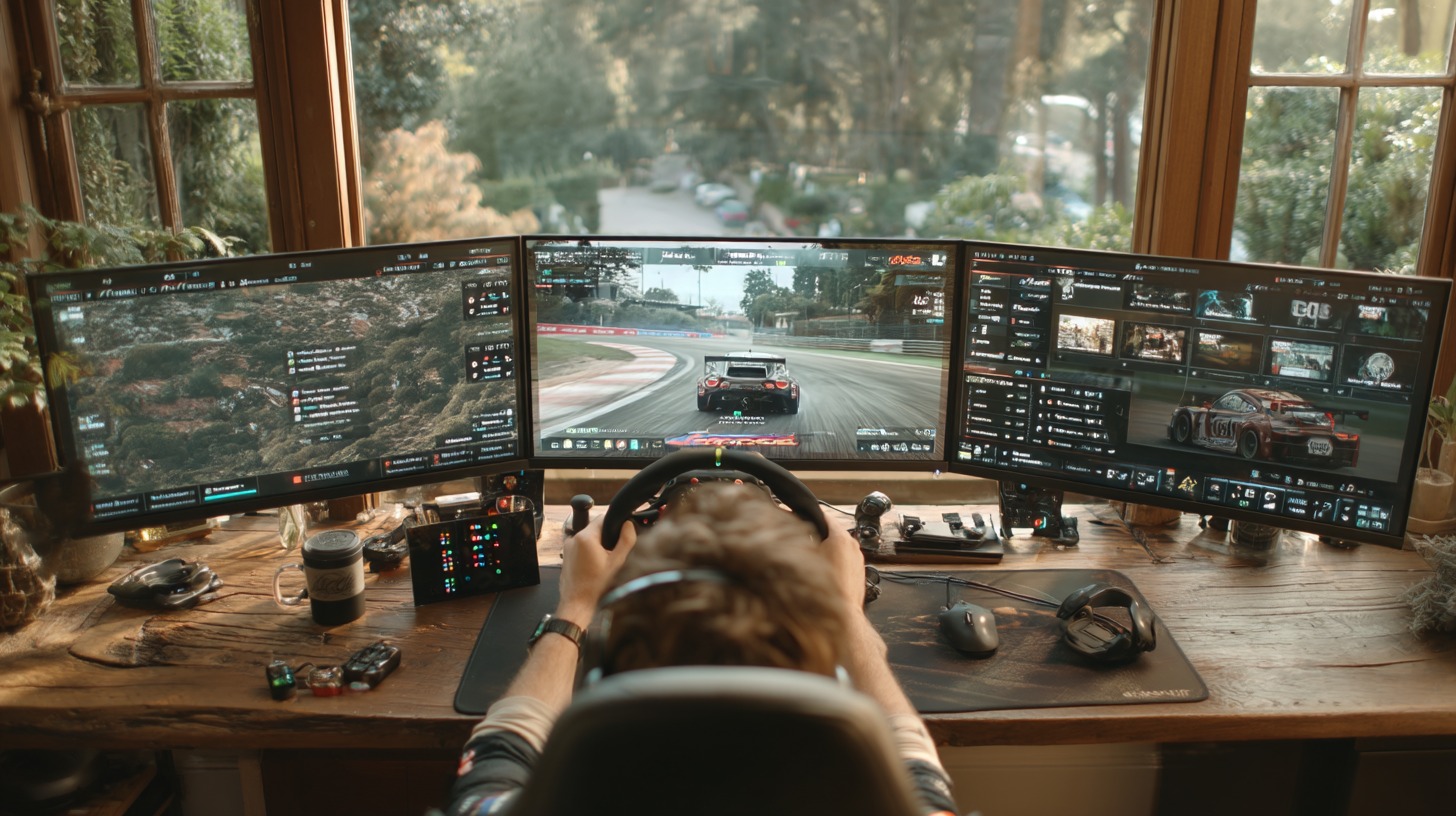
For beginners or those with limited space, a desk mount is a practical and affordable option. It lets you securely attach your wheel and pedals to a sturdy desk.
A sim racing cockpit offers a more realistic experience by replicating a real car’s seating position. With a dedicated frame for your wheel, pedals, and accessories, it provides better comfort, stability, and adjustability — ideal for serious racers seeking more control and immersion.
Optional extras
For even more realism, add-ons like a manual shifter or handbrake can elevate your setup. Paddle modules on your steering wheel can also provide extra inputs and can even replace pedal functions, which is ideal for users with disabilities or those not ready to invest in a full pedal set.
Quick releases and hubs
A quick release (QR) system connects the steering wheel to the wheel base. Its release mechanism allows you to swap wheels quickly and easily. The QR socket on the wheel base must be compatible with the QR on your wheel.
A hub is a mounting platform that lets you attach third-party wheel rims to your setup. It provides button inputs and structural support. Some hubs have an integrated quick release, while others require one to be added separately.
Different steering wheel shapes
Your choice of steering wheel shape depends on the driving you want to do:
- Round wheels: Best for rally or street-style racing, feeling like a regular car wheel.
- Formula-style wheels: Flat and wide, ideal for open-wheel racing like Formula 1.
- GT-style wheels: Often flat-bottomed, designed for circuit racing in sports cars.
PC or console?
While many products work on a Windows PC, console compatibility varies by hardware.
PC sim racing offers the most flexibility. It supports a wider range of hardware, advanced sims like iRacing and Assetto Corsa (with mods), and allows for better graphics and customization. However, a PC is more expensive and can be more technical to set up. Note that a PC is often required for hardware driver updates, even if you play on a console.
Consoles (PlayStation or Xbox) are more affordable and easier to set up, making them great for casual racers. Games like Gran Turismo and Forza offer solid experiences with minimal fuss. However, consoles have limitations: they support fewer accessories, and high-end gear like triple monitor setups won’t work. You’re also limited to the console’s ecosystem, and button mapping options can vary by game.


Recent Comments